
CALL US TODAY
770-591-5271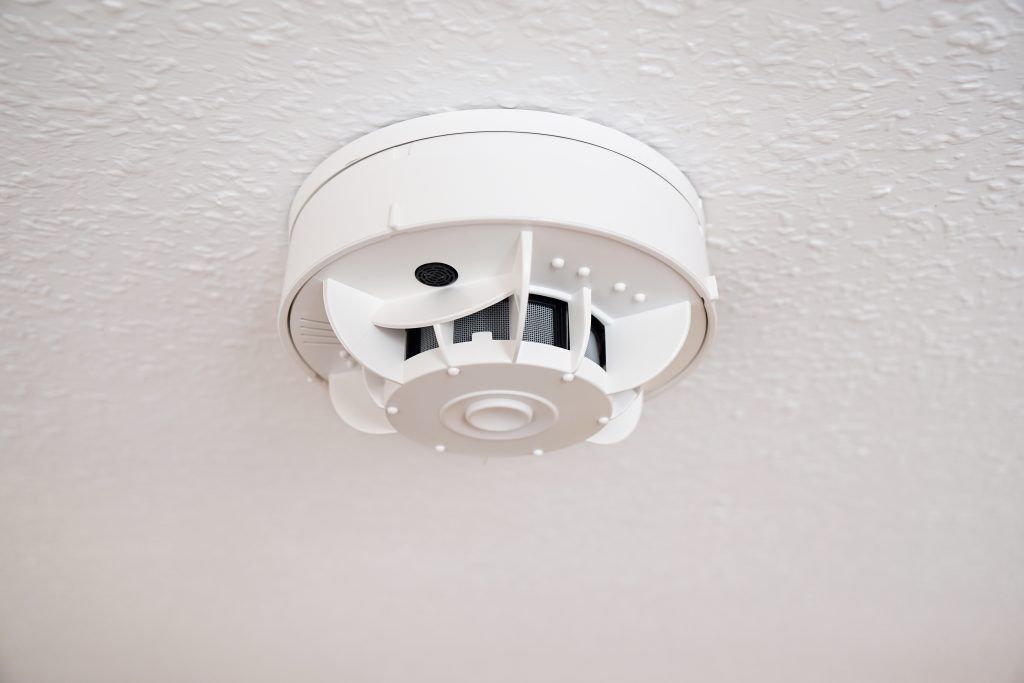
The smoke detector vs fire detector question tends to come up when a facility manager is reading a fire alarm quote or a fire marshal's report and sees both terms used for what looks like the same device. However, they aren't interchangeable. "Fire detector" is the broad category for any device that senses a fire, and a smoke detector is one type within it. Commercial fire alarm systems in metro Atlanta and Athens often combine more than one kind of detector, with each placed where it performs best.
NFPA 72, the National Fire Alarm and Signaling Code, sorts detection devices by the fire signature they respond to. Smoke detectors look for airborne particles of combustion. Heat detectors watch temperature, and flame detectors react to the infrared or ultraviolet energy an open flame gives off. Gas detectors belong to the same family.
All of these are fire detectors. The four main types of fire detectors found in commercial buildings each have a job, and the right combination depends on what goes on inside each room.
Smoke detectors generally use one of two sensing technologies. Ionization models pass a small electrical current through the air inside a chamber, and smoke particles entering the chamber disrupt that current and trigger the device. According to NIST research, ionization units tend to react faster to flaming fires because those fires release large numbers of small soot particles.
Photoelectric models aim a light source into a sensing chamber at an angle away from a light sensor. Smoke drifting into the chamber scatters light onto the sensor. This design generally responds faster to fires that begin with a long smoldering stage, which can fill a room with smoke well before there are visible flames.
Smoke detectors are considered life-safety devices. Honeywell points out that when people are hurt in a fire, smoke and toxic gases such as carbon monoxide are almost always the cause, and catching smoke early gives occupants more time to get out.
The trade-off is sensitivity. A detector tuned to catch almost any smoke will also react to cooking fumes and dust, and a less sensitive one may respond too late. Dust buildup is a common reason a smoke detector keeps beeping or trips without a fire.
Heat detectors ignore smoke entirely. Fixed-temperature models activate at a set point, and rate-of-rise models respond when the temperature climbs quickly. Smoldering fires produce little heat, so a heat detector usually responds later than a smoke detector would. Industry guidance treats heat detection as property protection rather than life safety, and Honeywell describes it as a reliable option where protecting the building is the main goal.
NFPA 72 requires a heat detector's temperature rating to sit at least 20 degrees above the ambient temperature at the ceiling. A hot mechanical room or kitchen shouldn't be able to set one off on its own.
Flame detectors sense the radiant energy of a flame and can respond before much smoke has collected. They're more specialized than smoke or heat detectors, and a system designer specifies them based on the particular hazard in a space.
Since every smoke detector is a fire detector, the smoke detector vs fire detector choice comes down to which type belongs in each area. Smoke detection is the usual choice wherever people work, shop, or stay overnight, because it gives the earliest warning.
Heat detection takes over in spaces where everyday conditions would keep a smoke detector in alarm. Commercial kitchens are the clearest example, since cooking smoke and steam are part of normal operations. Parking garages and loading areas deal with vehicle exhaust, and dusty storage or manufacturing spaces carry fine particles that can trip a smoke sensor.
A restaurant in Marietta, for example, might have photoelectric smoke detectors in the dining room and back office, heat detectors in the kitchen, and a kitchen fire suppression system protecting the cooking line. On an addressable fire alarm system, each of those detectors reports its own location to the panel, so responders and technicians can see exactly which device activated.
A smoke alarm senses smoke and sounds its own warning. A smoke detector only does the sensing and sends a signal to a fire alarm control panel, which then activates the building's notification devices. Commercial buildings that code requires to have a fire alarm system use system-connected detectors, so a battery smoke alarm from a hardware store isn't a substitute in those spaces.
Georgia's Safety Fire Commissioner adopts NFPA standards and the International Fire Code as the state minimum fire safety standards. Those rules carry the force of law statewide and apply to every building except one- and two-family dwellings and certain townhouses. Cities and counties can enforce stricter rules but can't adopt anything less protective.
Athens-Clarke County adopts the state standards by reference, and its Fire Marshal's Office inspects existing buildings to confirm fire protection systems are installed and maintained to work as intended. The adopted editions aren't always the newest ones NFPA has published, so the code a building is held to in Georgia may differ from what a national article describes. Before a fire marshal inspection, it helps to confirm each detector works and is the right type for its location.
Cliffs Fire is based in Atlanta and handles commercial fire alarm inspection and service for businesses in Marietta, Kennesaw, Smyrna, Roswell, Alpharetta, Holly Springs, and Athens. An inspection is a good time to confirm that smoke and heat detectors are working and that each one suits the space it protects. We also service fire sprinkler systems, fire extinguishers, kitchen suppression systems, and exit lighting, so businesses can work with one company across their fire protection.
If you're unsure whether your building has the right mix of detectors, contact our team to schedule a fire alarm inspection.


 ADDRESS


 Lume Sales & Marketing